
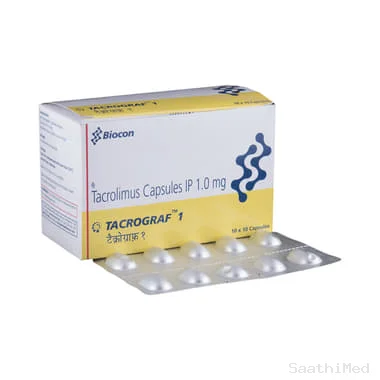
Pangraf 1 Capsule (Tacrolimus 1mg): Complete Medicine Guide
When to Call Your Doctor IMMEDIATELY
- Decreased urine output or swelling in legs
- Fever, chills, or sore throat
- Severe headache, confusion, seizures, or vision changes
- Chest pain or shortness of breath
- Severe abdominal pain radiating to the back
- Yellowing of skin or eyes
- Unusual bleeding or bruising
- Rash, blisters, or peeling skin
If experiencing severe symptoms, call emergency services immediately.
What is tacrograf 1 capsule used for?
This medicine contains tacrolimus 1 mg, an immunosuppressant used to prevent organ rejection after transplant. It works by blocking T-cell activation. It requires regular blood monitoring and should only be taken under specialist supervision.
- Generic Name: Tacrolimus (1mg)
- Manufacturer: Biocon
- Form: Allopathy
- Pregnancy Category: Consult doctor
- Prescription Required: Yes
🇮🇳 tacrograf 1 capsule के बारे में (Hindi Summary)
उपयोग: यह दवा टैक्रोलिमस 1 मिलीग्राम कैप्सूल है, जिसका उपयोग अंग प्रत्यारोपण के बाद शरीर की प्रतिरक्षा प्रणाली को दबाने के लिए किया जाता है ताकि नया अंग अस्वीकार न हो। यह कैल्सीन्यूरिन इनहिबिटर वर्ग की दवा है। यह किडनी, लिवर, हृदय और फेफड़े के प्रत्यारोपण में दी जाती है। इसके अलावा कुछ ऑटोइम्यून बीमारियों में भी डॉक्टर की सलाह पर दी जा सकती है। यह दवा केवल विशेषज्ञ चिकित्सक की देखरेख में ही लेनी चाहिए।
साइड इफेक्ट्स: इस दवा के सामान्य दुष्प्रभावों में कंपन, सिरदर्द, दस्त, मतली, बढ़ा हुआ रक्त शर्करा, उच्च रक्तचाप और गुर्दे की समस्या शामिल हैं। गंभीर दुष्प्रभावों में गुर्दे की क्षति, गंभीर संक्रमण और कुछ प्रकार के कैंसर का खतरा बढ़ना शामिल है। किसी भी असामान्य लक्षण को तुरंत डॉक्टर को बताएं।
सुरक्षा सलाह: इस दवा को डॉक्टर के बताए अनुसार ही लें। दवा की खुराक खुद से न बदलें और न ही बंद करें। नियमित रूप से रक्त परीक्षण करवाएं। संक्रमण से बचने के लिए सावधानी बरतें। धूप से बचाव करें क्योंकि इससे त्वचा कैंसर का खतरा बढ़ सकता है। ग्रेपफ्रूट और ग्रेपफ्रूट जूस से बचें। लाइव वैक्सीन न लगवाएं। किसी भी नई दवा या प्रक्रिया से पहले डॉक्टर को इस दवा के बारे में बताएं।
💊 tacrograf 1 capsule Uses & Benefits
- [{"condition":"Prophylaxis of organ rejection in kidney transplant recipients","description":"This medicine is used to prevent the immune system from rejecting a donated kidney.
- It is often part of a combination regimen with other immunosuppressants and corticosteroids.","evidence":"Well-established"},{"condition":"Prophylaxis of organ rejection in liver transplant recipients","description":"This medicine helps prevent rejection of a transplanted liver and is a standard part of immunosuppressive therapy after liver transplantation.","evidence":"Well-established"},{"condition":"Prophylaxis of organ rejection in heart transplant recipients","description":"This medicine is used to prevent rejection of a transplanted heart, usually in combination with other immunosuppressive agents.","evidence":"Well-established"},{"condition":"Prophylaxis of organ rejection in lung transplant recipients","description":"This medicine is part of immunosuppressive regimens to prevent rejection of transplanted lungs.","evidence":"Well-established"},{"condition":"Atopic dermatitis (off-label, when other treatments fail)","description":"In some severe cases of atopic dermatitis that do not respond to other therapies, tacrolimus may be used off-label, but this is not the primary use of the oral capsule.","evidence":"Limited"},{"condition":"Rheumatoid arthritis (off-label)","description":"Tacrolimus has been studied as a potential treatment for rheumatoid arthritis in patients who do not respond to conventional therapy, but it is not a first-line treatment.","evidence":"Limited"}]
Off-label uses: [{"condition":"Myasthenia gravis","description":"Tacrolimus has been used off-label in some patients with myasthenia gravis who have not responded to standard treatments.","evidence":"Limited"},{"condition":"Lupus nephritis","description":"Some studies suggest tacrolimus may be beneficial in lupus nephritis, but it is not approved for this indication.","evidence":"Limited"},{"condition":"Inflammatory bowel disease","description":"Tacrolimus has been used off-label in ulcerative colitis and Crohn's disease in selected cases.","evidence":"Limited"}]
Primary treatment for: Organ transplant rejection prophylaxis
Also treats: Atopic dermatitis (off-label), Rheumatoid arthritis (off-label), Myasthenia gravis (off-label), Lupus nephritis (off-label)
📋 Drug Information
| Generic Name(s) | Tacrolimus (1mg) |
| Brand Name | tacrograf 1 capsule |
| Manufacturer | Biocon |
| Packaging / Form | Varies by brand (Allopathy) |
| Therapeutic Class | ANTI NEOPLASTICS |
| Action Class | Immunosuppressant- Calcineurin inhibitors |
| Route of Administration | Oral |
| Storage | Store at room temperature between 15°C and 30°C (59°F to 86°F). Protect from light and moisture. Keep in the original container. Do not refrigerate unless specified by the manufacturer. |
| Shelf Life | The shelf life is typically 24 to 36 months from the date of manufacture, depending on the manufacturer. Check the expiry date on the packaging. |
| WHO Guideline | Not established from the available information. |
| ICMR Guideline | Not established from the available information. |
👨⚕️ Doctor's Practical Tips
Evidence-based practical advice from experienced clinicians
🔍 Is This Medicine Right for Your Symptom?
Educational reference. Always consult a doctor for diagnosis.
🔬 How This Medicine Works (Pharmacology)
Pharmacokinetics
How It Works
Tacrolimus binds to the intracellular protein FKBP-12, forming a complex that inhibits calcineurin, a phosphatase enzyme. This inhibition prevents the dephosphorylation and activation of nuclear factor of activated T-cells (NFAT), which is required for the transcription of interleukin-2 and other cytokines. As a result, T-lymphocyte activation and proliferation are suppressed, leading to reduced immune response against the transplanted organ.
Mechanism Steps
💡 How to Take tacrograf 1 capsule
Strength: Tacrolimus 1 mg immediate-release capsule
Dosage Information
| Adult Dosage | The dose of this medicine must be individualized by a qualified clinician based on the type of transplant, time since transplant, concomitant immunosuppressive therapy, and the patient's clinical status. For kidney transplant, a typical starting dose is 0.2 mg/kg/day divided into two doses, but this varies. For liver transplant, the starting dose is often 0.1 to 0.15 mg/kg/day divided into two doses. Doses are adjusted based on tacrolimus whole blood trough levels, kidney function, liver function, and signs of toxicity or rejection. Never adjust the dose without your doctor's guidance. |
| Pediatric Dosage | Pediatric dosing is not established from available information. Consult a pediatrician or transplant specialist for individualized dosing. |
| Elderly Dosage | Elderly patients may be more susceptible to the side effects of tacrolimus, especially kidney and neurological effects. Doses should be carefully adjusted based on renal function and tacrolimus blood levels. Regular monitoring is essential. |
| Renal Impairment | Tacrolimus is primarily metabolized by the liver, so renal impairment does not usually require a dose adjustment. However, because tacrolimus can cause nephrotoxicity, kidney function should be monitored closely, and doses should be adjusted based on tacrolimus blood levels and clinical response. |
| Hepatic Impairment | In patients with hepatic impairment, tacrolimus metabolism may be reduced, leading to increased blood levels. Doses should be reduced and tacrolimus blood levels monitored closely. Consult your doctor for individualized dosing. |
| Maximum Daily Dose | The maximum daily dose is individualized and should not exceed the dose determined by your clinician based on therapeutic drug monitoring. Do not exceed the prescribed dose. |
Dosage Timeline
🍽️ Food Timing Guide
⏰ What to Do If You Miss a Dose
⚠️ Side Effects of tacrograf 1 capsule
✅ Common Side Effects
🚨 Serious Side Effects
⚠️ Rare Side Effects
Consult your doctor if you experience any unusual symptoms.
🔬 Drug Interactions
| Drug | Severity | Effect |
|---|---|---|
| Ketoconazole | Major | |
| Rifampin | Major | |
| Ibuprofen | Moderate | |
| Diltiazem | Moderate | |
| Fluconazole | Moderate | |
| Spironolactone | Moderate | |
| Prednisone | Moderate | |
| Live vaccines | Major | |
| Grapefruit juice | Major | |
| St. John's wort | Major |
🚨 Major Interactions
- Strong CYP3A4 inhibitors (e.g., ketoconazole, itraconazole, clarithromycin, ritonavir)
- Strong CYP3A4 inducers (e.g., rifampin, carbamazepine, phenytoin, St. John's wort)
- Nephrotoxic drugs (e.g., amphotericin B, aminoglycosides, vancomycin, NSAIDs)
- Live vaccines
- Grapefruit juice
⚡ Moderate Interactions
- Calcium channel blockers (e.g., diltiazem, verapamil)
- Antifungals (e.g., fluconazole, voriconazole)
- Macrolide antibiotics (e.g., erythromycin)
- Potassium-sparing diuretics (e.g., spironolactone)
- Corticosteroids
🍷 Alcohol Interaction
Alcohol may increase the risk of liver problems and can affect tacrolimus levels. It is advisable to avoid or limit alcohol consumption while taking this medicine. Consult your doctor for personalized advice.
🔎 Check Your Other Medicines
Educational tool. Always confirm with your doctor or pharmacist.
🛡️ Safety & Warnings
🚫 Contraindications
["Hypersensitivity to tacrolimus or any component of the formulation","Concurrent use of live vaccines","Severe hepatic impairment","Pregnancy (unless benefit outweighs risk)","Breastfeeding"]
⚠️ Warnings & Precautions
["This medicine should only be prescribed by physicians experienced in immunosuppressive therapy and management of transplant patients.","Regular monitoring of tacrolimus blood levels, kidney function, liver function, blood sugar, and blood pressure is essential.","Avoid contact with individuals who have active infections; practice good hygiene.","Use effective sun protection to reduce the risk of skin cancer.","Do not receive live vaccines while taking this medicine.","Inform your doctor if you are pregnant, planning to become pregnant, or breastfeeding.","Avoid grapefruit and grapefruit juice.","Do not stop or change the dose without consulting your doctor.","This medicine may impair your ability to drive or operate machinery; avoid these activities until you know how it affects you.","Report any unusual symptoms, especially neurological or cardiac, immediately."]
🤱 Lactation Safety
Tacrolimus is excreted in human breast milk. Because of the potential for serious adverse reactions in nursing infants, a decision should be made whether to discontinue nursing or to discontinue the medicine, taking into account the importance of the medicine to the mother. Consult your doctor.
💊 Overdose Management
Overdose of tacrolimus can cause severe immunosuppression, nephrotoxicity, neurotoxicity, and other serious effects. There is no specific antidote. Treatment is supportive and symptomatic. In case of overdose, seek immediate medical attention. Gastric lavage may be considered if ingestion is recent. Monitor vital signs, kidney function, and tacrolimus blood levels closely.
⏰ Missed Dose
If you miss a dose of this medicine, take it as soon as you remember if it is within a few hours of the scheduled time. If it is almost time for your next dose, skip the missed dose and continue with your regular schedule. Do not take two doses at the same time to make up for a missed dose. If you are unsure, contact your doctor or pharmacist.
Additional Safety Advice
This medicine must only be taken exactly as prescribed by your transplant or immunology specialist. Do not change the dose or stop the medicine on your own, as this can lead to organ rejection. Take the capsule at the same times each day, preferably on an empty stomach or as directed, and keep all scheduled blood tests to monitor drug levels, kidney function, blood sugar, and blood pressure. Avoid contact with people who have active infections, and practice good hand hygiene. Use sunscreen and protective clothing because this medicine increases skin cancer risk. Do not receive live vaccines while taking this medicine. Inform any doctor, dentist, or pharmacist that you are taking this medicine before any procedure or new prescription. Avoid grapefruit and grapefruit juice, as they can raise drug levels. Limit alcohol consumption and never share this medicine with anyone else.
👴 Special Considerations for Elderly
💡 For Patients Above 65
Elderly patients may be more sensitive to the side effects of tacrolimus, especially kidney and neurological effects. Doses should be carefully adjusted, and monitoring should be more frequent.
🤰 Pregnancy Planning (TTC)
If you are planning to become pregnant, consult your doctor before conception. Tacrolimus may be continued during pregnancy if the benefits outweigh the risks, but close monitoring is required. Discuss all options with your healthcare provider.
🏥 Post-Surgery Considerations
After surgery, this medicine is often used to prevent rejection of transplanted organs. Follow your surgeon's and transplant team's instructions carefully. Report any signs of infection or rejection immediately.
🦷 Dental Procedures
Inform your dentist that you are taking this medicine before any dental procedure. You may need antibiotics to prevent infection. Avoid dental work during periods of high immunosuppression unless urgent.
💚 Lifestyle Tips for Better Results
🏋️ Exercise Considerations
Moderate exercise is generally encouraged, but avoid strenuous activities that could lead to injury or infection. Consult your doctor before starting any new exercise program. If you experience fatigue, shortness of breath, or swelling, stop and seek medical advice.
🥗 Diet Recommendations
💼 Impact on Daily Work & Life
This medicine may cause tremors, headache, or fatigue, which can affect your ability to drive or operate machinery. Avoid these activities until you know how the medicine affects you. Most patients can return to work after recovery from transplant, but follow your doctor's advice.
🛑 When to Stop This Medicine
Do not stop taking this medicine without consulting your doctor. Stopping suddenly can lead to organ rejection. Your doctor may adjust or stop the medicine based on your condition, but this must be done under medical supervision.
📅 Long-Term Use Effects
Long-term use of this medicine is often necessary to prevent organ rejection. It can lead to chronic kidney disease, increased risk of infections, and certain cancers. Regular monitoring of kidney function, blood levels, and overall health is essential. Dose may be adjusted over time based on your condition.
🌿 Non-Medicine Approaches
These can complement medicine but do not replace prescribed treatment.
Another calcineurin inhibitor that can be used as an alternative.
Evidence: Well-establishedAn mTOR inhibitor that may be used in some patients.
Evidence: Well-establishedOften used in combination with tacrolimus or as an alternative.
Evidence: Well-established💉 Vaccination Considerations
💉 If You're Getting Vaccinated
Live vaccines should not be administered while taking this medicine due to the risk of infection. Inactivated vaccines may be given, but the immune response may be reduced. Consult your doctor before any vaccination.
📦 Storage Guide
✅ DO
Store at room temperature (15-30°C)
❌ DON'T
Do not refrigerate unless specified
✅ DO
Keep in original container
❌ DON'T
Do not transfer to unmarked containers
✅ DO
Keep away from direct sunlight
❌ DON'T
Do not store in bathroom cabinet
✈️ Traveling with This Medicine
When traveling, carry this medicine in its original packaging with a copy of your prescription. Keep it in your carry-on luggage to avoid loss. Store at room temperature and protect from extreme heat or cold. If crossing time zones, consult your doctor about adjusting dosing times. Carry enough supply for your entire trip and a little extra in case of delays. Check customs regulations for carrying prescription medicines.
💰 Cost Analysis & Savings
👥 Real Patient Stories
Educational, anonymized scenarios. Individual results may vary.
💬 Questions Patients Often Ask
A: The immunosuppressive effects begin within hours, but the full protective effect against rejection develops over days to weeks as drug levels stabilize.
A: No. Stopping this medicine can lead to organ rejection. Always consult your doctor before making any changes.
A: If you remember within a few hours, take it. If it's almost time for the next dose, skip it. Do not double dose.
A: Avoid grapefruit and grapefruit juice, and St. John's wort. Be consistent with meals.
A: Live vaccines should be avoided. Inactivated vaccines may be given, but consult your doctor first.
🤔 Common Patient Concerns
🔄 Substitutes for tacrograf 1 capsule
View AllAlternative brands with exact same active ingredient:
-
limicort ointmentCatholicon Pharmaceuticals Pvt Ltd ₹267.19 38.3% CHEAPER
-
tacrolim 1mg capsuleDr Reddy's Laboratories Ltd ₹300.00 30.7% CHEAPER
-
amigraf 1.0 capsuleBiokindle Lifesciences Pvt Ltd ₹300.94 30.5% CHEAPER
-
nefrograf 1mg capsuleRenauxe Pharma India Pvt Ltd ₹320.00 26.1% CHEAPER
-
Tacimun 1mg CapsuleBharat Serums & Vaccines Ltd ₹332.16 23.3% CHEAPER
Medical Note: Always consult your doctor before switching medications.
🛑 Myths vs. Facts
- Myth: Tacrolimus can be stopped once the transplant is stable.
Fact: Tacrolimus is usually a lifelong medicine. Stopping it can lead to organ rejection. Always consult your doctor before making any changes. - Myth: Tacrolimus weakens the immune system permanently.
Fact: The immunosuppressive effect is reversible and depends on continued presence of the drug. However, long-term use is often necessary to prevent rejection. - Myth: You can take any over-the-counter medicine with tacrolimus.
Fact: Many medicines interact with tacrolimus. Always check with your doctor or pharmacist before taking any new medicine, including herbal products.
🔄 Alternative Options
Generic Alternatives
- Tacrolimus (generic)
Brand Alternatives
- Pangraf 1 Capsule