
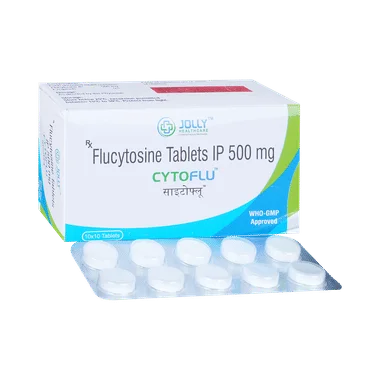
Cytoflu 500mg Tablet (Flucytosine): Complete Medicine Guide
Clinical Reference Standards: CDSCO (Central Drugs Standard Control Organisation), Indian Pharmacopoeia (IP) & WHO | Last Updated: September 2026
When to Call Your Doctor IMMEDIATELY
- Unusual bleeding or bruising
- Fever, chills, or signs of infection
- Severe fatigue or weakness
- Yellowing of skin or eyes (jaundice)
- Dark urine or decreased urine output
- Severe abdominal pain
- Shortness of breath or difficulty breathing
- Rash with blistering or peeling skin
If experiencing severe symptoms, call emergency services immediately.
What is cytoflu 500mg tablet used for?
This medicine is an antifungal medication used in combination with other antifungals to treat serious fungal infections such as cryptococcal meningitis and invasive candidiasis. It works by stopping the growth of fungi. It requires regular blood monitoring due to the risk of bone marrow suppression.
- Generic Name: Flucytosine
- Manufacturer: Jolly Healthcare
- Form: Allopathy
- Pregnancy Category: Consult doctor
- Prescription Required: Yes
🇮🇳 cytoflu 500mg tablet के बारे में (Hindi Summary)
उपयोग: यह दवा एक एंटीफंगल दवा है जिसका उपयोग गंभीर फंगल संक्रमणों जैसे क्रिप्टोकोकल मेनिनजाइटिस और इनवेसिव कैंडिडिआसिस के इलाज के लिए किया जाता है। यह अन्य एंटीफंगल दवाओं के साथ मिलकर काम करती है और फंगस को बढ़ने से रोकती है। यह दवा केवल डॉक्टर की देखरेख में ही लेनी चाहिए क्योंकि इससे खून की कोशिकाओं पर असर पड़ सकता है और नियमित रक्त जांच की आवश्यकता होती है।
साइड इफेक्ट्स: इस दवा के सामान्य दुष्प्रभावों में मतली, उल्टी, दस्त, पेट दर्द, सिरदर्द और त्वचा पर चकत्ते शामिल हैं। गंभीर दुष्प्रभावों में रक्त कोशिकाओं का कम बनना, जिससे एनीमिया, संक्रमण का खतरा और रक्तस्राव की समस्या हो सकती है, शामिल है। लीवर और किडनी पर भी असर हो सकता है। इसलिए नियमित रक्त जांच और डॉक्टर की निगरानी बहुत जरूरी है।
सुरक्षा सलाह: इस दवा को केवल डॉक्टर के निर्देशानुसार ही लें। नियमित रक्त जांच करवाते रहें ताकि खून, लीवर और किडनी पर पड़ने वाले असर का पता चल सके। दवा को भोजन के साथ या बिना भोजन के ले सकते हैं, लेकिन अगर पेट खराब लगे तो भोजन के साथ लें। शराब न पिएं क्योंकि इससे लीवर पर असर बढ़ सकता है। दवा लेना अचानक बंद न करें, डॉक्टर से पूछकर ही बंद करें।
💊 cytoflu 500mg tablet Uses & Benefits
[{"condition":"Cryptococcal meningitis","description":"This medicine is used in combination with amphotericin B, with or without fluconazole, for the treatment of cryptococcal meningitis, a serious fungal infection of the membranes surrounding the brain and spinal cord.","evidence":"Well-established"},{"condition":"Invasive candidiasis","description":"This medicine may be used as part of combination therapy for severe invasive candidiasis, including candidemia, when other antifungal agents are not adequate or are contraindicated.","evidence":"Established"},{"condition":"Chromoblastomycosis","description":"This medicine has been used in the treatment of chromoblastomycosis, a chronic fungal infection of the skin and subcutaneous tissues, although it is not a first-line treatment.","evidence":"Limited"}]
Off-label uses: [{"condition":"Aspergillosis","description":"This medicine has been used off-label in combination with other antifungals for the treatment of invasive aspergillosis, but its role is not well defined.","evidence":"Limited"},{"condition":"Cryptococcosis in immunocompromised patients","description":"This medicine may be used off-label for maintenance therapy in patients with HIV/AIDS and cryptococcal disease after initial treatment.","evidence":"Limited"}]
Primary treatment for: Cryptococcal meningitis
Also treats: Invasive candidiasis, Chromoblastomycosis
📋 Drug Information
| Generic Name(s) | Flucytosine |
| Brand Name | Cytoflu 500mg Tablet |
| Manufacturer | Jolly Healthcare |
| Packaging / Form | Varies by brand (Allopathy) |
| Therapeutic Class | ANTI INFECTIVES |
| Action Class | Fluorinated pyrimidine-antifungal |
| Route of Administration | Oral |
| Storage | Store this medicine at room temperature between 15°C and 30°C (59°F to 86°F) in a dry place, away from direct sunlight and moisture. Keep it in its original container, tightly closed. |
| Shelf Life | The shelf life of this medicine is typically 24 months from the date of manufacture, but refer to the packaging for the exact expiry date. |
| WHO Guideline | The World Health Organization recommends flucytosine in combination with amphotericin B as the preferred induction therapy for cryptococcal meningitis in adults, adolescents, and children. This combination is also recommended for the treatment of invasive candidiasis in certain settings. |
| ICMR Guideline | The Indian Council of Medical Research guidelines for the management of cryptococcal meningitis recommend the use of flucytosine in combination with amphotericin B for induction therapy, followed by fluconazole for consolidation and maintenance therapy. |
👨⚕️ Doctor's Practical Tips
Evidence-based practical advice from experienced clinicians
🔍 Is This Medicine Right for Your Symptom?
Educational reference. Always consult a doctor for diagnosis.
🔬 How This Medicine Works (Pharmacology)
Pharmacokinetics
How It Works
This medicine works by entering fungal cells and being converted into 5-fluorouracil, which is then incorporated into fungal RNA and inhibits DNA synthesis. This dual action disrupts protein synthesis and cell division, leading to fungal cell death. It is primarily fungistatic against susceptible fungi, meaning it stops their growth rather than directly killing them, and its effectiveness depends on the immune system of the patient and the combination with other antifungal agents.
Mechanism Steps
💡 How to Take cytoflu 500mg tablet
Strength: This medicine is available as a 500mg immediate-release tablet for oral administration.
Dosage Information
| Adult Dosage | The usual adult dose of this medicine is 50 to 150 mg per kilogram of body weight per day, divided into four doses given every 6 hours. The exact dose depends on the type and severity of the fungal infection, the patient's kidney function, and whether it is used alone or with other antifungal medicines. Dose must be individualized by a qualified clinician based on indication, age, weight, renal and hepatic function. Regular blood tests are required to monitor for toxicity and to adjust the dose. |
| Pediatric Dosage | Pediatric dosing is not established from available information. Consult a pediatrician. |
| Elderly Dosage | Elderly patients may have reduced kidney function, which can increase the risk of toxicity from this medicine. Dose adjustment based on creatinine clearance is recommended. Close monitoring of blood counts, liver, and kidney function is advised. |
| Renal Impairment | In patients with renal impairment, the dose of this medicine must be reduced and the dosing interval extended based on creatinine clearance. For creatinine clearance 20-40 mL/min, the dose may be reduced to 25-50 mg/kg/day; for creatinine clearance 10-20 mL/min, further reduction is needed. In patients on hemodialysis, an additional dose may be required after dialysis. Dose must be individualized by a qualified clinician. |
| Hepatic Impairment | In patients with hepatic impairment, this medicine should be used with caution. No specific dose adjustment guidelines are available, but liver function should be monitored closely. Dose must be individualized by a qualified clinician. |
| Maximum Daily Dose | The maximum recommended daily dose of this medicine is 150 mg/kg/day, but this may be lower depending on renal function and toxicity. Dose must be individualized by a qualified clinician. |
Dosage Timeline
🍽️ Food Timing Guide
⏰ What to Do If You Miss a Dose
⚠️ Side Effects of cytoflu 500mg tablet
✅ Common Side Effects
🚨 Serious Side Effects
⚠️ Rare Side Effects
Consult your doctor if you experience any unusual symptoms.
🔬 Drug Interactions
| Drug | Severity | Effect |
|---|---|---|
| Amphotericin B | Major | |
| Fluconazole | Major | |
| Cytarabine | Major | |
| Aminoglycosides | Moderate | |
| NSAIDs | Moderate | |
| Methotrexate | Moderate | |
| Isoniazid | Moderate | |
| Antacids | Minor |
🚨 Major Interactions
- Amphotericin B
- Fluconazole
- Cytarabine
⚡ Moderate Interactions
- Nephrotoxic drugs (e.g., aminoglycosides, NSAIDs)
- Hepatotoxic drugs (e.g., methotrexate, isoniazid)
🍷 Alcohol Interaction
Alcohol should be avoided while taking this medicine because it may increase the risk of liver toxicity and worsen side effects such as nausea and dizziness.
🔎 Check Your Other Medicines
Educational tool. Always confirm with your doctor or pharmacist.
🛡️ Safety & Warnings
🚫 Contraindications
["Known hypersensitivity to flucytosine or any component of the formulation","Severe renal impairment (creatinine clearance < 20 mL/min) without dose adjustment and monitoring","Severe hepatic impairment","Pregnancy (unless the potential benefit outweighs the risk)","Breastfeeding (unless the potential benefit outweighs the risk)"]
⚠️ Warnings & Precautions
["This medicine can cause severe bone marrow suppression, leading to anemia, neutropenia, and thrombocytopenia. Regular blood counts are essential.","This medicine should be used with caution in patients with renal impairment. Dose adjustment is required based on creatinine clearance.","This medicine should be used with caution in patients with liver disease. Liver function should be monitored.","This medicine may cause severe skin reactions. Patients should be advised to report any rash immediately.","This medicine should not be used as monotherapy for serious fungal infections due to the risk of resistance.","Patients should be advised to avoid alcohol while taking this medicine.","This medicine may impair the ability to drive or operate machinery if dizziness or fatigue occurs."]
🤱 Lactation Safety
It is not known whether this medicine is excreted in human breast milk. Because many drugs are excreted in human milk and because of the potential for serious adverse reactions in nursing infants, a decision should be made whether to discontinue nursing or to discontinue the drug, taking into account the importance of the drug to the mother.
💊 Overdose Management
Overdose of this medicine can cause severe bone marrow suppression, liver toxicity, and kidney toxicity. There is no specific antidote. Treatment is supportive and symptomatic. In case of overdose, stop the medicine and seek immediate medical attention. Hemodialysis may be considered to remove the drug from the bloodstream in severe cases.
⏰ Missed Dose
If you miss a dose of this medicine, take it as soon as you remember. If it is almost time for your next dose, skip the missed dose and continue with your regular dosing schedule. Do not take a double dose to make up for a missed one.
Additional Safety Advice
This medicine must only be taken under the supervision of a qualified clinician, and regular blood tests are essential to monitor for bone marrow suppression, liver, and kidney problems. Take this medicine exactly as prescribed, with or without food, but if it causes stomach upset, take it with a meal or snack. Do not stop taking this medicine without consulting your doctor, even if you feel better, because stopping early can lead to the infection returning or becoming resistant. Inform your doctor about all other medicines you are taking, especially other antifungals, because this medicine can interact with them. Avoid alcohol while taking this medicine as it may increase the risk of liver problems. If you miss a dose, take it as soon as you remember, but if it is almost time for the next dose, skip the missed dose and continue with your regular schedule. Do not double the dose. Keep this medicine out of reach of children and store it at room temperature away from moisture and heat.
👴 Special Considerations for Elderly
💡 For Patients Above 65
Elderly patients are more likely to have reduced kidney function, which can increase the risk of toxicity from this medicine. Dose adjustment based on creatinine clearance is recommended. Close monitoring of blood counts, liver, and kidney function is advised.
🤰 Pregnancy Planning (TTC)
If you are planning to become pregnant, discuss with your doctor before taking this medicine. This medicine is Pregnancy Category C and should be used during pregnancy only if the potential benefit justifies the potential risk. Effective contraception should be used during treatment.
🏥 Post-Surgery Considerations
If you have recently had surgery, inform your surgeon and anesthesiologist that you are taking this medicine. It may affect wound healing and increase the risk of bleeding or infection. Close monitoring is advised.
🦷 Dental Procedures
Inform your dentist that you are taking this medicine before any dental procedure. This medicine can increase the risk of bleeding and infection, so your dentist may take extra precautions.
💚 Lifestyle Tips for Better Results
🏋️ Exercise Considerations
This medicine may cause fatigue or dizziness. Avoid strenuous exercise if you feel weak or dizzy. Light activities like walking are generally safe, but consult your doctor before starting any exercise program.
🥗 Diet Recommendations
💼 Impact on Daily Work & Life
This medicine may cause fatigue, dizziness, or nausea, which can affect your ability to drive or operate machinery. It is advisable to avoid driving or operating heavy machinery until you know how this medicine affects you. You may need to take time off work during the initial phase of treatment.
🛑 When to Stop This Medicine
Do not stop taking this medicine without consulting your doctor. Your doctor will decide when to stop based on your response to treatment and blood test results. Stopping early can lead to relapse or resistance.
📅 Long-Term Use Effects
Long-term use of this medicine may increase the risk of bone marrow suppression, liver toxicity, and kidney toxicity. Regular monitoring of blood counts, liver, and kidney function is essential. The risk of these effects increases with higher doses and longer duration of therapy. Patients should be monitored closely and dose adjustments made as needed.
🌿 Non-Medicine Approaches
These can complement medicine but do not replace prescribed treatment.
May be used as an alternative if this medicine is not tolerated or contraindicated, but it has more side effects.
Evidence: Well-establishedMay be used for less severe infections or as maintenance therapy.
Evidence: Established💉 Vaccination Considerations
💉 If You're Getting Vaccinated
There are no specific vaccine interactions with this medicine. However, live vaccines should be avoided in immunocompromised patients. Consult your doctor before receiving any vaccinations.
📦 Storage Guide
✅ DO
Store at room temperature (15-30°C)
❌ DON'T
Do not refrigerate unless specified
✅ DO
Keep in original container
❌ DON'T
Do not transfer to unmarked containers
✅ DO
Keep away from direct sunlight
❌ DON'T
Do not store in bathroom cabinet
✈️ Traveling with This Medicine
When traveling, carry this medicine in its original packaging with a copy of your prescription. Keep it in your hand luggage to avoid loss or temperature extremes. If crossing time zones, adjust dosing times gradually in consultation with your doctor. Store at room temperature and avoid leaving it in a hot car. Check customs regulations for carrying prescription medicines.
💰 Cost Analysis & Savings
👥 Real Patient Stories
Educational, anonymized scenarios. Individual results may vary.
💬 Questions Patients Often Ask
A: Clinical improvement may be seen within days to weeks, but the full course of treatment may last several weeks to months depending on the infection.
A: Yes, you can take it with or without food. If it causes stomach upset, take it with a meal or snack.
A: Take the missed dose as soon as you remember. If it is almost time for your next dose, skip the missed dose and continue with your regular schedule. Do not double the dose.
A: This medicine is Pregnancy Category C. It should be used during pregnancy only if the potential benefit justifies the potential risk to the fetus. Consult your doctor.
A: No, you should complete the full course as prescribed. Stopping early can lead to the infection returning or becoming resistant.
🤔 Common Patient Concerns
🔄 Substitutes for cytoflu 500mg tablet
View AllAlternative brands with exact same active ingredient:
-
fcfung 500 tabletGlenmark Pharmaceuticals Ltd ₹1,312.50 89.6% CHEAPER
-
cytorx 500mg tabletCipla Ltd ₹1,475.00 88.3% CHEAPER
Medical Note: Always consult your doctor before switching medications.
🛑 Myths vs. Facts
- Myth: This medicine can cure any fungal infection.
Fact: This medicine is only effective against certain serious systemic fungal infections and is not used for common superficial fungal infections like athlete's foot. - Myth: This medicine is safe to take without blood tests.
Fact: This medicine can cause serious blood-related side effects, so regular blood tests are mandatory during treatment. - Myth: This medicine can be stopped as soon as symptoms improve.
Fact: Stopping this medicine early can lead to the infection returning or becoming resistant. Always complete the full course as prescribed.
🔄 Alternative Options
Generic Alternatives
- Flucytosine 500mg tablet
Brand Alternatives
- Ancobon
- Flucytosine