
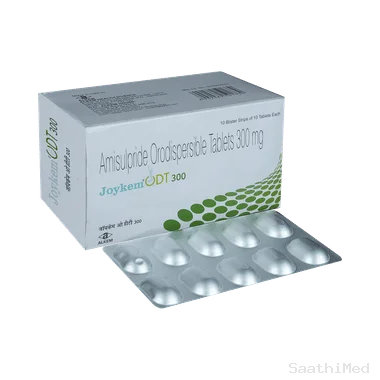
Amazeo 300 Tablet (Amisulpride 300mg): Uses, Side Effects, and Safety Information
Clinical Reference Standards: CDSCO (Central Drugs Standard Control Organisation), Indian Pharmacopoeia (IP) & WHO | Last Updated: September 2026
What is joykem odt 300 tablet used for?
Amazeo 300 Tablet contains Amisulpride 300 mg, an atypical antipsychotic used to treat schizophrenia and other psychotic disorders. It works by blocking dopamine D2 and D3 receptors in the brain, helping to reduce hallucinations, delusions, and other symptoms. It is available only on prescription and must be used under medical supervision.
- Generic Name: Amisulpride (300mg)
- Manufacturer: Alkem Laboratories Ltd
- Form: Allopathy
- Pregnancy Category: Consult doctor
- Prescription Required: Yes
🇮🇳 joykem odt 300 tablet के बारे में (Hindi Summary)
उपयोग: यह दवा एमिसलप्राइड 300 मिलीग्राम युक्त एक एंटीसाइकोटिक है, जिसका उपयोग स्किज़ोफ्रेनिया और अन्य मानसिक विकारों के इलाज में किया जाता है। यह मस्तिष्क में डोपामाइन रिसेप्टर्स को ब्लॉक करके मतिभ्रम, भ्रम और अन्य लक्षणों को कम करने में मदद करती है।
साइड इफेक्ट्स: सामान्य दुष्प्रभावों में अनिद्रा, चिंता, उनींदापन, वजन बढ़ना, मतली, कब्ज और मुँह सूखना शामिल हैं। गंभीर दुष्प्रभावों में न्यूरोलेप्टिक मैलिग्नेंट सिंड्रोम, टार्डिव डिस्किनेसिया और हृदय संबंधी समस्याएँ हो सकती हैं।
सुरक्षा सलाह: इस दवा को केवल डॉक्टर के परामर्श से ही लें। शराब से बचें क्योंकि इससे नींद और चक्कर बढ़ सकते हैं। गुर्दे या यकृत की समस्या हो तो डॉक्टर को बताएं। गर्भावस्था या स्तनपान के दौरान डॉक्टर से सलाह लें।
💊 joykem odt 300 tablet Uses & Benefits
[{"condition":"Schizophrenia","description":"This medicine is used to treat acute and chronic schizophrenia, helping to reduce positive symptoms such as hallucinations and delusions as well as negative symptoms such as apathy and social withdrawal."},{"condition":"Acute psychotic episodes","description":"It may be used to control acute psychotic symptoms in conditions such as schizoaffective disorder or other psychotic disorders, as determined by a specialist."}]
Off-label uses: [{"condition":"Treatment-resistant depression","description":"Amisulpride has been studied as an adjunctive treatment in some cases of depression, but this use is not approved for all patients and must be decided by a specialist."},{"condition":"Dysthymia","description":"Low-dose amisulpride has been investigated for persistent depressive disorder, but this is not a standard approved indication for the 300 mg tablet."}]
Primary treatment for: Schizophrenia
Also treats: Schizoaffective disorder, Acute psychotic episodes
📋 Drug Information
| Generic Name(s) | Amisulpride (300mg) |
| Brand Name | joykem odt 300 tablet |
| Manufacturer | Alkem Laboratories Ltd |
| Packaging / Form | Varies by brand (Allopathy) |
| Therapeutic Class | NEURO CNS |
| Action Class | Atypical Antipsychotics |
| Route of Administration | Oral |
| Storage | Store below 30°C in a dry place, protected from light and moisture. Keep out of reach of children. |
| Shelf Life | Not established from the available information. Refer to the product packaging for the expiry date. |
| WHO Guideline | Not established from the available information. |
| ICMR Guideline | Not established from the available information. |
🔬 How This Medicine Works (Pharmacology)
Pharmacokinetics
How It Works
Amisulpride is an atypical antipsychotic that selectively blocks dopamine D2 and D3 receptors in the brain. At higher doses it predominantly blocks postsynaptic D2 receptors in the limbic system, which helps reduce positive psychotic symptoms. At lower doses it preferentially blocks presynaptic D3/D2 autoreceptors, which can enhance dopaminergic transmission in the frontal cortex and improve negative symptoms. It has minimal affinity for serotonin, histamine, muscarinic, and adrenergic receptors, which contributes to its relatively favourable side-effect profile compared with some other antipsychotics.
Mechanism Steps
💡 How to Take joykem odt 300 tablet
Strength: 300 mg
Dosage Information
| Adult Dosage | The usual adult dose for schizophrenia ranges from 400 mg to 800 mg daily, given in divided doses or as a single dose depending on the formulation and clinical response. Doses above 800 mg daily have not been shown to be more effective and may increase side effects. The exact dose must be determined by a qualified clinician based on the individual's condition, response, and renal function. |
| Pediatric Dosage | The safety and efficacy of amisulpride in children and adolescents have not been established. Dose must be determined by a qualified clinician based on indication, age, weight, and renal/hepatic function. |
| Elderly Dosage | Elderly patients may be more sensitive to the effects of amisulpride and are at higher risk of side effects. A lower starting dose may be appropriate, and renal function should be assessed before initiating treatment. Dose must be determined by a qualified clinician. |
| Renal Impairment | In patients with renal impairment, the dose of amisulpride should be reduced according to creatinine clearance. For creatinine clearance between 30 and 60 mL/min, the dose should be halved. For creatinine clearance between 10 and 30 mL/min, the dose should be reduced to one-third of the usual dose. Amisulpride is contraindicated in severe renal impairment with creatinine clearance less than 10 mL/min. |
| Hepatic Impairment | Amisulpride undergoes limited hepatic metabolism, so dose adjustment may not be necessary in mild to moderate hepatic impairment. However, caution is advised, and dose must be determined by a qualified clinician based on individual assessment. |
| Maximum Daily Dose | The maximum recommended daily dose is 800 mg for adults, but doses above 800 mg have not been shown to be more effective and may increase the risk of adverse effects. |
Dosage Timeline
⚠️ Side Effects of joykem odt 300 tablet
✅ Common Side Effects
🚨 Serious Side Effects
⚠️ Rare Side Effects
Consult your doctor if you experience any unusual symptoms.
🔬 Drug Interactions
| Drug | Severity | Effect |
|---|---|---|
| Minor | ||
| Minor | ||
| Minor | ||
| Minor | ||
| Minor | ||
| Minor | ||
| Minor |
🚨 Major Interactions
- Other antipsychotics or dopamine antagonists
- QT-prolonging drugs such as certain antiarrhythmics, antibiotics, and antihistamines
- Levodopa and other dopamine agonists
⚡ Moderate Interactions
- Antihypertensive medicines
- CNS depressants such as benzodiazepines and opioids
- Alcohol
🍷 Alcohol Interaction
Alcohol should be avoided while taking this medicine because it can increase drowsiness, dizziness, and impairment of judgement and motor skills.
🛡️ Safety & Warnings
🚫 Contraindications
["Hypersensitivity to amisulpride or any component of the formulation.","Phaeochromocytoma.","Prolactin-dependent tumours such as pituitary prolactinoma or breast cancer.","Severe renal impairment (creatinine clearance less than 10 mL/min).","Concurrent use with levodopa or other dopamine agonists in patients with Parkinson's disease.","Known QT interval prolongation or congenital long QT syndrome.","Concurrent use with drugs known to prolong the QT interval."]
⚠️ Warnings & Precautions
[{"warning":"Neuroleptic malignant syndrome","reason":"A potentially fatal reaction characterised by hyperthermia, muscle rigidity, and autonomic instability.","action":"Discontinue immediately and seek emergency medical care if suspected."},{"warning":"Tardive dyskinesia","reason":"Involuntary movements may develop with long-term use.","action":"Monitor for abnormal movements; consider dose reduction or discontinuation if present."},{"warning":"QT prolongation","reason":"Increased risk of serious cardiac arrhythmias.","action":"Perform ECG monitoring and correct electrolyte imbalances; avoid concurrent QT-prolonging drugs."},{"warning":"Renal impairment","reason":"Reduced clearance may lead to accumulation and toxicity.","action":"Adjust dose according to creatinine clearance; monitor renal function."},{"warning":"Elderly patients with dementia","reason":"Increased risk of cerebrovascular events and mortality.","action":"Use with caution; consider alternative treatments."},{"warning":"Venous thromboembolism","reason":"Antipsychotics may increase the risk of blood clots.","action":"Monitor for signs and symptoms; consider prophylaxis in at-risk patients."},{"warning":"Hyperprolactinaemia","reason":"Amisulpride can elevate prolactin levels.","action":"Monitor for endocrine symptoms; consider dose reduction or alternative if significant."}]
🤱 Lactation Safety
Amisulpride may pass into breast milk. Breastfeeding is not recommended while taking this medicine unless advised by a specialist after weighing the benefits and risks.
💊 Overdose Management
Overdose of amisulpride may cause severe drowsiness, hypotension, tachycardia, QT prolongation, and extrapyramidal symptoms. There is no specific antidote. Management should be supportive and symptomatic, including cardiac monitoring, correction of electrolyte imbalances, and treatment of arrhythmias. Gastric lavage may be considered if the patient presents early. Contact a poison control centre or emergency services immediately.
⏰ Missed Dose
If a dose is missed, take it as soon as remembered unless it is almost time for the next dose. Do not double the dose to make up for a missed one. If in doubt, follow the advice given by your prescriber.
Additional Safety Advice
This medicine should only be taken when prescribed by a qualified clinician. Do not stop or change the dose without medical advice, as abrupt withdrawal can cause relapse or withdrawal symptoms. Avoid alcohol while taking this medicine because it can increase drowsiness and impair judgement. Inform your doctor if you have kidney or liver problems, heart disease, epilepsy, Parkinson's disease, or a history of blood clots. Regular monitoring of symptoms, weight, blood pressure, blood counts, and heart rhythm may be required. Use effective contraception if you are of childbearing potential, and tell your doctor immediately if you become pregnant or plan to become pregnant. Do not drive or operate heavy machinery until you know how this medicine affects you.
🔄 Substitutes for joykem odt 300 tablet
View AllAlternative brands with exact same active ingredient:
-
skizotus od tabletEmcure Pharmaceuticals Ltd ₹184.60 58.1% CHEAPER
-
sulpra 300mg tabletReliance Formulation Pvt Ltd ₹207.00 53% CHEAPER
-
exam 300mg tablet erAltius Life Sciences ₹225.00 48.9% CHEAPER
-
skizotus 300mg tabletEmcure Pharmaceuticals Ltd ₹236.95 46.2% CHEAPER
-
joypride 300mg tabletLinux Laboratories ₹248.20 43.7% CHEAPER
Medical Note: Always consult your doctor before switching medications.
🛑 Myths vs. Facts
- Myth: Amazeo 300 Tablet is a sleeping pill.
Fact: This medicine is an antipsychotic used for schizophrenia and psychotic disorders, not a sleeping aid. - Myth: You can stop taking Amazeo 300 Tablet once you feel better.
Fact: Stopping suddenly can cause relapse or withdrawal symptoms; always consult your doctor before stopping. - Myth: Amazeo 300 Tablet is addictive.
Fact: Amisulpride is not considered an addictive drug, but it should only be used under medical supervision.