
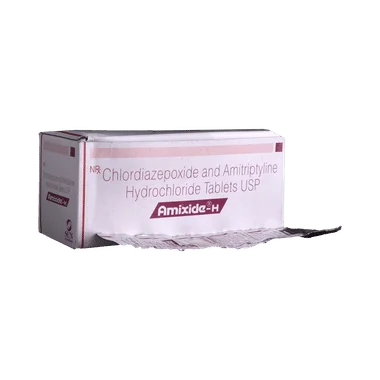
Amixide-H Tablet: Complete Guide to Uses, Side Effects, Dosage, and Safety
When to Call Your Doctor IMMEDIATELY
- Irregular or rapid heartbeat, palpitations, or fainting
- Severe allergic reaction: swelling of face, lips, tongue, or throat, or difficulty breathing
- Yellowing of skin or eyes, dark urine, or severe abdominal pain
- Seizures or severe confusion
- Inability to pass urine or severe lower abdominal pain
- Severe drowsiness, slowed breathing, or unresponsiveness
- New or worsening suicidal thoughts or self-harm urges
- Severe withdrawal symptoms after stopping the medicine, such as tremors, anxiety, or seizures
If experiencing severe symptoms, call emergency services immediately.
What is amixide-h tablet used for?
This medicine is a combination of Amitriptyline 12.5 mg and Chlordiazepoxide 5 mg used for short-term relief of anxiety with depressive symptoms. It works by increasing brain chemicals that improve mood and by enhancing the calming effect of GABA. It causes drowsiness and can be habit-forming, so it must be taken exactly as prescribed and never stopped suddenly.
- Generic Name: Amitriptyline + Chlordiazepoxide
- Manufacturer: Sun Pharmaceutical Industries Ltd
- Form: Allopathy
- Pregnancy Category: Consult doctor
- Prescription Required: Yes
🇮🇳 amixide-h tablet के बारे में (Hindi Summary)
उपयोग: यह दवा अमिट्रिप्टिलीन 12.5 मिलीग्राम और क्लोरडायजेपॉक्साइड 5 मिलीग्राम का संयोजन है। इसका उपयोग चिंता और अवसाद के लक्षणों के अल्पकालिक उपचार के लिए किया जाता है। यह मनोदशा को बेहतर बनाने और चिंता को कम करने में मदद करती है। यह दवा नींद लाने और मांसपेशियों को आराम देने में भी सहायक है। इसे डॉक्टर के निर्देशानुसार ही लें। इसका सेवन अकेले न करें और शराब के साथ बिल्कुल न लें।
साइड इफेक्ट्स: इस दवा के सामान्य दुष्प्रभावों में नींद आना, मुँह सूखना, धुंधली दृष्टि, कब्ज, चक्कर आना और पेशाब में कठिनाई शामिल हैं। कुछ लोगों में वजन बढ़ सकता है या पसीना आ सकता है। गंभीर दुष्प्रभावों में अनियमित दिल की धड़कन, एलर्जी, और खून की बीमारियाँ शामिल हैं। अगर आपको सांस लेने में तकलीफ, चेहरे या गले में सूजन, या दिल की धड़कन में गड़बड़ी महसूस हो, तो तुरंत डॉक्टर से मिलें।
सुरक्षा सलाह: इस दवा को डॉक्टर के बताए अनुसार ही लें, आमतौर पर रात को सोने से पहले। दवा लेने के बाद गाड़ी न चलाएँ और मशीनरी से दूर रहें। शराब का सेवन बिल्कुल न करें। इस दवा को अचानक बंद न करें, क्योंकि इससे withdrawal के लक्षण हो सकते हैं। डॉक्टर से नियमित जाँच कराते रहें। अगर आप गर्भवती हैं या स्तनपान करा रही हैं, तो डॉक्टर को तुरंत बताएँ।
💊 amixide-h tablet Uses & Benefits
[{"condition":"Anxiety with depressive symptoms","description":"This medicine is used for short-term management of anxiety that occurs together with low mood, worry, and tension.","evidence":"Well-established for short-term use"},{"condition":"Tension-related muscle pain","description":"The combination may help relieve muscle tightness and pain linked to psychological stress.","evidence":"Limited, often used in clinical practice"},{"condition":"Psychosomatic disorders","description":"Sometimes prescribed when physical symptoms are thought to be worsened by emotional stress.","evidence":"Limited"},{"condition":"Insomnia associated with anxiety","description":"The sedative effects can help with sleep when anxiety is the main cause of sleeplessness.","evidence":"Supportive, short-term use only"}]
Off-label uses: [{"condition":"Neuropathic pain","description":"Amitriptyline alone is sometimes used for nerve pain, but the combination is not standard for this purpose.","evidence":"Limited"},{"condition":"Irritable bowel syndrome","description":"Occasionally used for gut symptoms linked to stress, but not a first-line treatment.","evidence":"Limited"},{"condition":"Chronic headache prophylaxis","description":"Amitriptyline has some evidence in headache prevention, but the added benzodiazepine is not usually recommended long-term.","evidence":"Limited"}]
Primary treatment for: Anxiety with depressive symptoms
Also treats: Tension-related muscle pain, Psychosomatic disorders, Insomnia due to anxiety
📋 Drug Information
| Generic Name(s) | Amitriptyline + Chlordiazepoxide |
| Brand Name | Amixide-H Tablet |
| Manufacturer | Sun Pharmaceutical Industries Ltd |
| Packaging / Form | Varies by brand (Allopathy) |
| Therapeutic Class | NEURO CNS |
| Action Class | Tricyclic antidepressant + Benzodiazepine |
| Route of Administration | Oral |
| Storage | Store at room temperature between 15°C and 30°C (59°F to 86°F). Keep in a cool, dry place away from direct sunlight and moisture. Do not refrigerate unless specifically instructed. Keep out of reach of children and pets. |
| Shelf Life | Typically 24 months from the date of manufacture, but refer to the expiry date printed on the pack. Do not use after the expiry date. |
| WHO Guideline | Not established from the available information. This combination is not specifically recommended in WHO guidelines for first-line treatment of anxiety or depression. |
| ICMR Guideline | Not established from the available information. ICMR guidelines do not specifically recommend this fixed-dose combination as a first-line treatment. |
👨⚕️ Doctor's Practical Tips
Evidence-based practical advice from experienced clinicians
🔍 Is This Medicine Right for Your Symptom?
Educational reference. Always consult a doctor for diagnosis.
🔬 How This Medicine Works (Pharmacology)
Pharmacokinetics
How It Works
This medicine combines two active ingredients with different but complementary actions. Amitriptyline blocks the reuptake of serotonin and norepinephrine in the brain, which helps improve mood and reduces pain signals. It also blocks histamine H1 receptors, muscarinic acetylcholine receptors, and alpha-1 adrenergic receptors, which explains its sedative, dry mouth, and blood pressure effects. Chlordiazepoxide enhances the effect of gamma-aminobutyric acid (GABA) at GABA-A receptors, producing calmness, reduced anxiety, muscle relaxation, and sleepiness. Together, they reduce anxiety and depressive symptoms more effectively than either alone for short-term therapy.
Mechanism Steps
💡 How to Take amixide-h tablet
Strength: Tablet containing Amitriptyline 12.5 mg and Chlordiazepoxide 5 mg.
Dosage Information
| Adult Dosage | The usual adult dose of this medicine is one tablet taken orally at bedtime, but the exact dose and frequency must be individualized by a qualified clinician based on the indication, severity of symptoms, age, weight, and renal and hepatic function. Some patients may be started on a lower dose and gradually increased. The maximum daily dose should not be exceeded. Do not self-adjust the dose. Always follow your doctor's prescription. |
| Pediatric Dosage | Pediatric dosing is not established from available information. This medicine is not recommended for children. Consult a pediatrician for appropriate treatment. |
| Elderly Dosage | Elderly patients are more sensitive to the sedative, anticholinergic, and cognitive effects of this medicine. Start with a lower dose and titrate slowly. Monitor closely for falls, confusion, and urinary retention. The dose must be individualized by a qualified clinician. |
| Renal Impairment | Dose adjustment may be needed in patients with severe renal impairment. Both amitriptyline and chlordiazepoxide are excreted by the kidneys. Consult your doctor for appropriate dosing. Monitor renal function regularly. |
| Hepatic Impairment | Dose reduction is recommended in patients with hepatic impairment because both ingredients are metabolized in the liver. Use with caution and monitor liver function. The dose must be individualized by a qualified clinician. |
| Maximum Daily Dose | The maximum daily dose is not established from available information. Do not exceed the dose prescribed by your doctor. |
Dosage Timeline
🍽️ Food Timing Guide
⏰ What to Do If You Miss a Dose
⚠️ Side Effects of amixide-h tablet
✅ Common Side Effects
🚨 Serious Side Effects
⚠️ Rare Side Effects
Consult your doctor if you experience any unusual symptoms.
🔬 Drug Interactions
| Drug | Severity | Effect |
|---|---|---|
| MAOIs | Major | |
| Opioids | Major | |
| Alcohol | Major | |
| Fluoxetine | Major | |
| Ketoconazole | Major | |
| Oxybutynin | Moderate | |
| Amlodipine | Moderate | |
| Cimetidine | Moderate | |
| Antacids | Minor | |
| Caffeine | Minor |
🚨 Major Interactions
- Monoamine oxidase inhibitors (MAOIs)
- Other central nervous system depressants (opioids, alcohol, barbiturates, benzodiazepines)
- CYP2D6 inhibitors (e.g., fluoxetine, paroxetine, quinidine)
- CYP3A4 inhibitors (e.g., ketoconazole, clarithromycin)
⚡ Moderate Interactions
- Anticholinergic drugs (e.g., oxybutynin, benztropine)
- Antihypertensive drugs
- Thyroid medications
- Cimetidine
🍷 Alcohol Interaction
Alcohol must be completely avoided while taking this medicine. Both amitriptyline and chlordiazepoxide depress the central nervous system, and alcohol adds to this effect, causing severe drowsiness, impaired coordination, memory problems, and potentially dangerous slowing of breathing. Alcohol can also worsen depression and anxiety, which this medicine is meant to treat.
🔎 Check Your Other Medicines
Educational tool. Always confirm with your doctor or pharmacist.
🛡️ Safety & Warnings
🚫 Contraindications
["Known allergy to amitriptyline, chlordiazepoxide, or any other benzodiazepine","Concurrent use of monoamine oxidase inhibitors (MAOIs) or within 14 days of stopping an MAOI","Acute narrow-angle glaucoma","Urinary retention or severe difficulty passing urine","Severe liver disease","Myasthenia gravis","Severe respiratory depression","Acute porphyria","Pregnancy (unless clearly needed and advised by a doctor)","Breastfeeding without medical advice"]
⚠️ Warnings & Precautions
["This medicine can cause significant drowsiness. Do not drive or operate machinery until you know how it affects you.","Avoid alcohol and other central nervous system depressants.","Do not stop this medicine suddenly, as withdrawal symptoms can occur. Taper gradually under medical supervision.","Chlordiazepoxide can cause dependence, even at therapeutic doses, especially with long-term use.","Amitriptyline may increase the risk of suicidal thoughts or behavior, especially in young adults. Monitor closely for mood changes.","Use with caution in elderly patients, who are more sensitive to sedation, confusion, and falls.","Inform your doctor if you have heart disease, thyroid disease, glaucoma, prostate enlargement, or liver or kidney disease.","This medicine may affect your ability to regulate body temperature. Avoid extreme heat or cold.","Tell your doctor about all other medicines you are taking, including over-the-counter products and herbal supplements."]
🤱 Lactation Safety
Amitriptyline and chlordiazepoxide are excreted in breast milk. Chlordiazepoxide can accumulate in breastfed infants and cause sedation, poor feeding, and weight loss. Breastfeeding is not recommended while taking this medicine unless specifically advised by your doctor. Consult your doctor for alternative options.
💊 Overdose Management
Overdose of this medicine can be life-threatening. Symptoms include severe drowsiness, confusion, agitation, hallucinations, irregular heartbeat, low blood pressure, seizures, and coma. If you suspect an overdose, call emergency services immediately. Do not wait for symptoms to worsen. Treatment is supportive and may include activated charcoal, gastric lavage, intravenous fluids, and cardiac monitoring. There is no specific antidote for amitriptyline; physostigmine may be used cautiously for severe anticholinergic effects. Flumazenil may be used for benzodiazepine overdose but can precipitate seizures in mixed overdose. Always seek emergency medical help.
⏰ Missed Dose
If you miss a dose, take it as soon as you remember, unless it is almost time for your next dose. If it is within a few hours of your next dose, skip the missed dose and continue with your regular schedule. Do not take a double dose to make up for a missed one. If you miss several doses, contact your doctor before restarting, as abrupt discontinuation can cause withdrawal symptoms.
Additional Safety Advice
Take this medicine exactly as your doctor prescribes, usually at bedtime to reduce daytime drowsiness. Do not drive, operate heavy machinery, or do anything requiring alertness until you know how this medicine affects you. Avoid alcohol completely, as it can dangerously increase sedation and impair breathing. Do not stop this medicine suddenly, because withdrawal symptoms can occur; your doctor will reduce the dose gradually. Tell your doctor if you have heart disease, glaucoma, an enlarged prostate, thyroid problems, or liver or kidney disease. Keep all follow-up appointments so your doctor can monitor your response and adjust the dose. Store this medicine in a cool, dry place away from children and pets. If you become pregnant or plan to become pregnant, contact your doctor immediately.
👴 Special Considerations for Elderly
💡 For Patients Above 65
Elderly patients are more sensitive to the sedative, anticholinergic, and cognitive effects of this medicine. They are at higher risk of falls, confusion, urinary retention, and low blood pressure. Start with a lower dose and titrate slowly. Regular monitoring of kidney and liver function is advised. Avoid long-term use if possible.
🤰 Pregnancy Planning (TTC)
If you are planning to become pregnant, talk to your doctor before conceiving. This medicine may not be safe during pregnancy, especially in the first trimester. Your doctor may switch you to a safer alternative or adjust your treatment plan. Do not stop the medicine suddenly on your own.
🏥 Post-Surgery Considerations
Inform your surgeon and anesthesiologist that you are taking this medicine before any surgery. It can interact with anesthetic agents and increase sedation and respiratory depression. Your doctor may advise you to stop the medicine temporarily before surgery, but only under medical supervision.
🦷 Dental Procedures
Tell your dentist that you are taking this medicine before any dental procedure. It can cause dry mouth, which increases the risk of dental problems. It may also interact with sedatives or anesthetics used during dental work. Your dentist may recommend frequent dental check-ups and good oral hygiene.
💚 Lifestyle Tips for Better Results
🏋️ Exercise Considerations
This medicine can cause drowsiness, dizziness, and impaired coordination. Avoid strenuous exercise or activities that require balance until you know how the medicine affects you. Drink plenty of water during exercise to avoid dehydration, which can worsen dizziness. If you feel faint or unusually tired, stop and rest.
🥗 Diet Recommendations
💼 Impact on Daily Work & Life
This medicine can significantly affect your ability to work, especially if your job requires alertness, driving, or operating machinery. Drowsiness and dizziness are common, particularly in the first few weeks. You may need to adjust your work schedule or duties temporarily. Avoid driving until you know how the medicine affects you. Discuss any work-related concerns with your doctor.
🛑 When to Stop This Medicine
Do not stop this medicine on your own. Your doctor will decide when and how to stop based on your response and the duration of treatment. If you need to stop, the dose will be reduced gradually over days to weeks to prevent withdrawal symptoms. Seek immediate medical advice if you experience severe withdrawal symptoms such as seizures, severe anxiety, or tremors.
📅 Long-Term Use Effects
Long-term use of this medicine can lead to tolerance and dependence on the chlordiazepoxide component, making it harder to stop. Amitriptyline may cause weight gain, dental problems due to dry mouth, and rarely, heart rhythm changes. Regular monitoring of mood, heart health, liver function, and blood counts may be needed. The need for continued use should be reassessed periodically by your doctor, and the dose should be tapered gradually when stopping.
🌿 Non-Medicine Approaches
These can complement medicine but do not replace prescribed treatment.
A talking therapy that can be as effective as medication for anxiety and depression, without dependence risk.
Evidence: Well-establishedAlternative antidepressants with a better safety profile for long-term use, though they may not help with immediate anxiety.
Evidence: Well-establishedCan complement or reduce the need for medication in mild cases.
Evidence: SupportiveHas been shown to improve mood and reduce anxiety.
Evidence: Well-established💉 Vaccination Considerations
💉 If You're Getting Vaccinated
There are no specific vaccine interactions reported with this medicine. However, if you are feeling unwell or have a fever, consult your doctor before receiving any vaccine. Keep your vaccination records up to date as part of general health care.
📦 Storage Guide
✅ DO
Store at room temperature (15-30°C)
❌ DON'T
Do not refrigerate unless specified
✅ DO
Keep in the original container with the label intact
❌ DON'T
Do not transfer to unmarked containers
✅ DO
Keep away from direct sunlight and moisture
❌ DON'T
Do not store in the bathroom cabinet
✅ DO
Keep out of reach of children and pets
❌ DON'T
Do not share this medicine with others
✈️ Traveling with This Medicine
When traveling, carry this medicine in its original packaging with the prescription label clearly visible. Bring a copy of your prescription or a letter from your doctor, especially for international travel, as this medicine contains a controlled substance (chlordiazepoxide) and may be subject to customs regulations. Keep the medicine in your carry-on luggage to avoid loss or temperature extremes. If crossing time zones, ask your doctor how to adjust the timing of your doses. Store at room temperature and avoid leaving it in a hot car or checked luggage. Do not share this medicine with anyone else.
💰 Cost Analysis & Savings
👥 Real Patient Stories
Educational, anonymized scenarios. Individual results may vary.
💬 Questions Patients Often Ask
A: The calming and sedative effects may begin within 30-60 minutes. The antidepressant effect usually takes 1-2 weeks to become noticeable and may take 4-6 weeks for full benefit.
A: It is usually taken at bedtime because it causes drowsiness. If your doctor advises daytime dosing, avoid driving or operating machinery.
A: The chlordiazepoxide component can cause dependence, especially with long-term use. It should be used for the shortest possible time and tapered gradually when stopping.
A: If you remember within a few hours, take it. If it is almost time for your next dose, skip the missed dose. Do not double dose.
A: No. Stopping suddenly can cause withdrawal symptoms such as anxiety, insomnia, tremors, and seizures. Always taper under medical supervision.
🤔 Common Patient Concerns
🔄 Substitutes for amixide-h tablet
View AllAlternative brands with exact same active ingredient:
-
calmzee-c tabletZeelab Pharmacy Pvt Ltd ₹6.00 90.4% CHEAPER
-
amitrol 12.5mg/5mg tabletTorrent Pharmaceuticals Ltd ₹7.41 88.2% CHEAPER
-
lodep plus 12.5mg/5mg tabletDensa Pharmaceuticals Pvt Ltd ₹10.30 83.6% CHEAPER
-
Sereval Plus H 12.5mg/5mg TabletOsho Pharma Pvt Ltd ₹11.00 82.5% CHEAPER
-
amilite h 12.5mg/5mg tabletElite Pharma Pvt Ltd ₹12.19 80.6% CHEAPER
Medical Note: Always consult your doctor before switching medications.
🛑 Myths vs. Facts
- Myth: This medicine is a sleeping pill.
Fact: It is not a sleeping pill. It is a combination of an antidepressant and an anti-anxiety medicine that can cause drowsiness as a side effect. - Myth: I can stop this medicine whenever I feel better.
Fact: Stopping suddenly can cause withdrawal symptoms. Always taper gradually under medical supervision. - Myth: This medicine is safe to take with alcohol.
Fact: Alcohol is dangerous with this medicine. It can cause severe sedation and breathing problems. - Myth: This medicine works immediately.
Fact: The calming effect may start within an hour, but the antidepressant effect takes 1-2 weeks or longer.
🔄 Alternative Options
Generic Alternatives
- Amitriptyline + Chlordiazepoxide (generic)
Brand Alternatives
- Amixide-H Tablet